
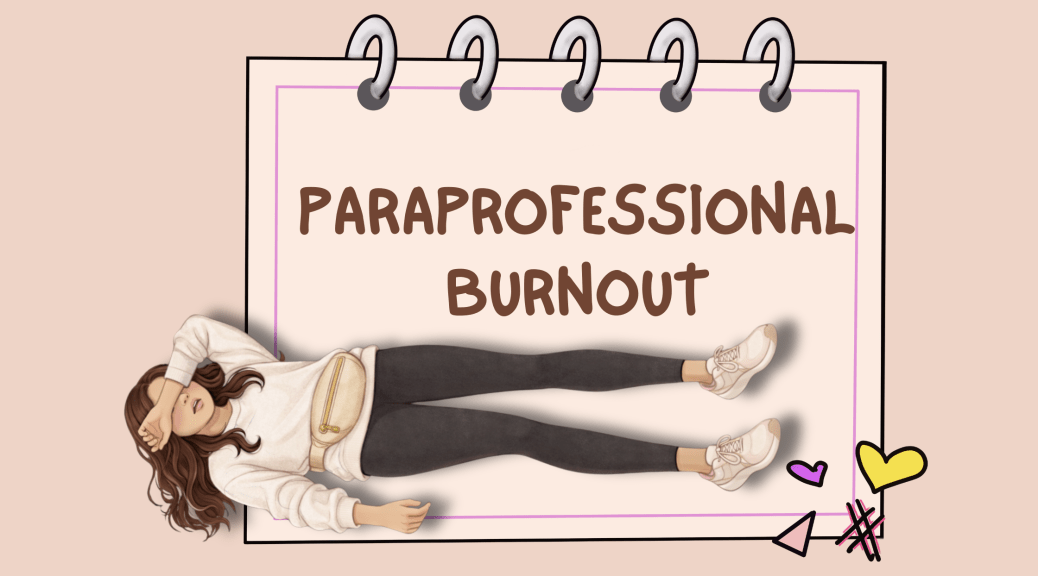
Before I became a paraprofessional, no one sat me down and said this out loud:
This job will take more out of you than you expect.
Not in a dramatic way at first.
Not in a “I can’t do this” kind of way.
But in a quiet, steady way… where one day you realize you’re just really tired.
And not just physically.
Mentally. Emotionally. Even spiritually sometimes.
I’ve been a paraprofessional for 4 years in a public elementary school, working in a self-contained autism classroom. I’ve worked across grade levels, and I’m currently with 3rd grade.
And while I expected the job to be busy… I didn’t fully understand how much of myself I would be giving every single day.
Because working in a special education classroom isn’t just about helping.
It’s about being constantly aware.
You’re watching for triggers.
You’re adjusting in real time.
You’re trying to stay one step ahead of behaviors that can shift quickly.
Even when everything looks calm on the outside, your mind is still working.
There are moments during the day where everything changes in seconds.
A student becomes overwhelmed.
A behavior escalates.
The room shifts.
And in that moment, you don’t really get time to think.
You just respond.
You stay calm—or at least try to.
You redirect.
You support.
You keep everyone safe.
And then a few minutes later, it’s over.
The classroom resets.
But your body doesn’t reset as quickly.
You’re still holding that tension, even if no one else sees it.
And that’s the part people don’t always understand about being a paraprofessional.
They don’t see how much you’re holding in just to keep the environment steady.
They don’t see the mental energy it takes to stay patient when you’re overwhelmed.
They don’t see the moments where you walk away thinking,
“Did I handle that right?”
There are also days where it’s not even one specific moment—it’s just the weight of everything combined.
The constant movement.
The unpredictability.
The feeling of always needing to be “on.”
And sometimes, feeling like what you do isn’t fully understood.
Like you’re doing a lot, but it’s happening quietly… in the background.
And then you go home.
And this is the part that really doesn’t get talked about enough.
I’m a mom of two school-aged kids. I work all day as a paraprofessional, and I’m also working toward my master’s degree to become a teacher.
So when I get home, the day doesn’t end—it shifts.
And if I’m being completely honest… there are days where I come home and I don’t even want to clean.
Not because I don’t care.
Not because I’m lazy.
But because I’ve already given so much of my energy throughout the day that there’s just not much left.
And then you still have:
- your kids
- your responsibilities
- your goals
All needing something from you.
Some days, just getting through everything is the win.
And I think that’s the part that deserves more recognition.
Because being a paraprofessional doesn’t exist in isolation.
It’s layered into real life.
You’re balancing work, home, and often your own personal growth at the same time.
For me, one of the biggest things that helps me stay grounded in this role is my faith.
There are moments where I have to pause and remind myself to respond with patience instead of frustration.
To choose grace, even when I feel stretched.
To look at the student in front of me and remember there’s more going on beneath the behavior.
I don’t get that right every day.
But having that perspective helps me keep showing up.
Why paraprofessionals burn out
Paraprofessional burnout doesn’t usually happen all at once.
It builds over time.
It comes from:
- constant emotional engagement
- physical demands
- the need to stay regulated for others
- feeling responsible for so much throughout the day
And often, not having a space to fully release that.
Burnout isn’t a sign that you’re not strong enough.
It’s often a sign that you’ve been strong for too long without a break.
Is paraprofessional burnout normal?
Yes—especially in special education settings.
When you’re supporting students with behavioral, emotional, and communication needs, the role requires a high level of patience and awareness.
Feeling tired, stretched, or overwhelmed at times doesn’t mean you’re doing something wrong.
It means you’re human in a role that asks a lot from you.



 Classroom Chíc