
Let me just say it…
If behavior isn’t under control, nothing else in your classroom matters.
You can have the cutest setup, the best lesson plans, and all the patience in the world—but if students are running, hitting, or completely disengaged, your whole day can fall apart fast.
And in a special education or autism classroom, it’s not about being strict—it’s about giving students the right tools to actually understand expectations.
P.S. I turned these into a free printable you can download below 👇
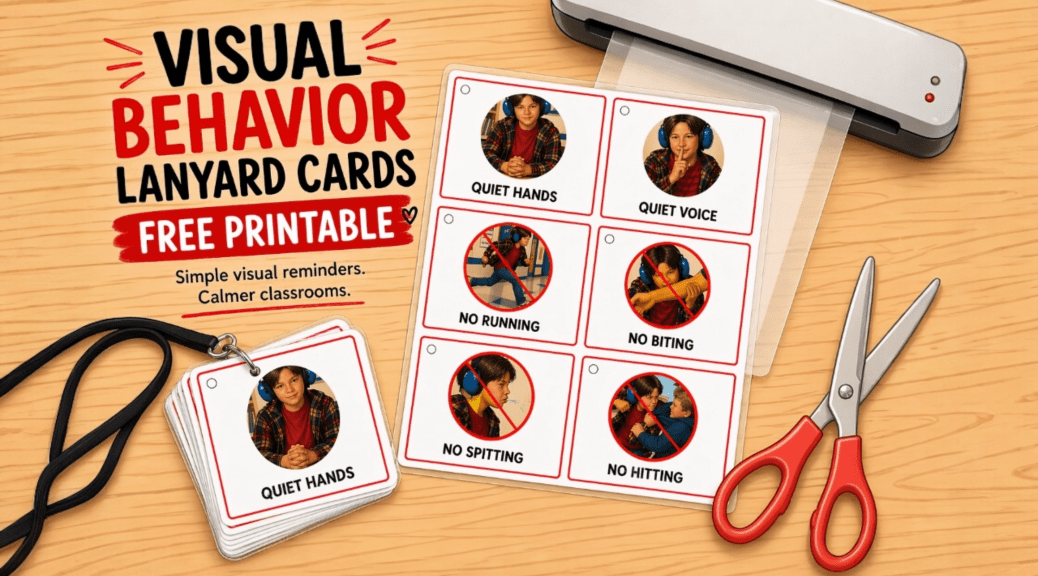
What Are Visual Behavior Lanyard Cards?
Visual behavior lanyard cards are portable visual supports that help students understand what to do (and what not to do) without needing constant verbal reminders.
Instead of repeating yourself all day:
- “Stop running”
- “Quiet voice”
- “Hands to yourself”
You simply show the card.
And for many students—especially those with autism—that’s all they need.
These cards include clear behavior reminders like:
- Quiet hands
- Quiet voice
- No running
- No biting
- No hitting
- No kicking
- No spitting
- No picking nose
These are real, everyday classroom behaviors, which is exactly why having them ready on a lanyard makes such a big difference.
Why Visual Supports Work (Especially in Autism Classrooms)
Here’s the truth:
Many students don’t process verbal directions quickly—especially in the moment.
When a child is overwhelmed or dysregulated, adding more words usually doesn’t help… it can actually make things worse.
Visual supports:
✔ reduce language processing demands
✔ provide clear, immediate expectations
✔ stay consistent every time
✔ help students become more independent
Instead of escalating situations by repeating yourself, visuals allow you to redirect calmly, quickly, and effectively.
Why I Chose Realistic Images (Not Stick Figures)
This part was very intentional.
When I created these cards, I chose to use realistic-looking behavior images instead of stick figures or simple icons.
Because in my classroom, I’ve seen this over and over again:
👉 Students respond better to visuals they can actually relate to.
When a child sees a realistic image showing “no hitting” or “quiet hands,” it clicks faster because it feels familiar and meaningful.
Stick figures can be too abstract for some learners, especially those who need very clear, concrete examples.
But realistic visuals:
✔ show exactly what the behavior looks like
✔ reduce confusion
✔ improve understanding
✔ lead to quicker responses
And I’ve seen it firsthand—students respond faster and more independently when the visuals feel real.
A Real Classroom Moment
You’re walking your class in the hallway.
One student starts running.
You say, “Walk please.”
No response.
You say it again.
Still nothing.
Now it’s turning into a whole situation.
Now imagine this instead:
You hold up the “No Running” card.
No lecture. No repeating yourself.
Just a quick visual cue.
And they slow down.
That’s the difference.
What Makes These Behavior Cards Actually Useful
These weren’t made just to look nice—they were made to work in real classrooms.
✔ Lanyard + Keychain Options
You get both:
- Lanyard-sized cards for staff use
- Keychain-sized cards for easy, portable support
✔ Simple, Clear Design
No clutter. No distractions.
Just clean visuals students can understand instantly.
✔ Built for Everyday Use
Print → laminate → hole punch → attach
They’re made to hold up in busy classrooms and daily use.
How to Use Visual Behavior Cards in Your Classroom
Here’s what actually works:
1. Pre-correct before behaviors happen
Show “quiet voice” or “quiet hands” before transitions or group time.
2. Replace repeated verbal reminders
If you’ve said it more than twice—switch to the visual.
3. Stay calm when using them
Just show the card, point if needed, and move on.
4. Be consistent
Use the same visuals daily so students learn them quickly.
5. Let students use them too
Some students can carry their own keychain version and begin self-monitoring.
Who These Visual Cards Are Perfect For
These are especially helpful for:
- Autism classrooms
- Special education settings
- Students with behavior intervention plans (BIPs)
- Nonverbal or minimally verbal learners
- Students with ADHD or sensory needs
- Paraprofessionals and support staff
If behavior is part of your day (and it is), these will help.
The Bigger Picture
This isn’t just about stopping behaviors.
It’s about:
- teaching expectations clearly
- reducing frustration
- supporting communication
- building independence
And doing it in a way that respects the student.
Teacher Real Talk
You don’t need another complicated system.
You don’t need a behavior chart that takes forever to manage.
Sometimes the simplest tools are the most effective.
And these?
They actually work.
🎉 Free Visual Behavior Lanyard Cards (Download Below)
If you’ve made it this far, you already know—sometimes you just need something that works without overcomplicating your day.
That’s exactly why I created these visual behavior lanyard cards based on real experiences in my autism classroom.
These aren’t just cute visuals—they’re designed with realistic behaviors that students can actually relate to, which helps them understand expectations faster and respond more independently.
Inside this free download, you’ll get:
✔ Lanyard-sized visual cue cards for staff use
✔ Keychain-sized cards for quick, on-the-go support
✔ Clear behavior reminders like quiet hands, quiet voice, and no running
✔ Realistic visuals (not confusing stick figures) that make expectations easy to understand
👇 Download your free visual behavior cards here:
Teacher tip: Print on cardstock, laminate, and attach to a lanyard or keychain for daily use.
Final Thoughts
At the end of the day, behavior support doesn’t have to be complicated.
Sometimes the simplest tools—like clear, realistic visual cues—make the biggest difference.
If you’re constantly repeating yourself or trying to manage behaviors in the moment, this is something you’ll actually use every single day.



 Classroom Chíc